
Career Change After 40 in India: Why Planning Early Matters
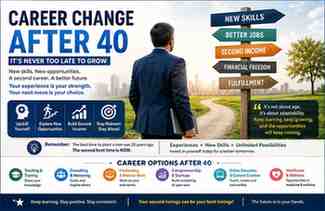
Career Change After 40 in India
A career is not always a straight line from the first job to retirement.
Many employees begin their careers in their 20s, spend 10–15 years developing expertise and gradually reach senior positions. However, the employment environment can change significantly as employees grow older. Technology changes, companies restructure, new skills become important, automation increases and some organisations reduce positions during business downturns.
This raises an important question:
Should employees wait until they lose their job before thinking about a career change?
The answer is generally no.
For many professionals, especially those approaching 35–40 years of age, it can be useful to think about career diversification, continuous learning, a second income source and alternative career options well before an emergency occurs.
A career change at 40 is possible. In fact, professionals in their 40s often bring valuable experience, industry knowledge, communication skills and problem-solving abilities that younger candidates may not yet have. Career guidance sources also emphasise using existing transferable skills rather than treating a career change as starting completely from zero.
Why Employees Consider a Career Switch After 2–3 Years
Consider an employee who has worked in a company for two or three years.
During this period, the employee may have gained:
- Practical industry knowledge
- Technical skills
- Knowledge of company processes
- Client-handling experience
- Communication skills
- Project experience
- Teamwork experience
- Problem-solving ability
- Knowledge of industry tools
- Professional contacts
After gaining this experience, changing companies can sometimes provide opportunities for better salary, better responsibilities and exposure to different technologies.
A career switch does not necessarily mean completely changing the profession.
For example:
| Current Role | Possible Career Switch |
|---|---|
| Software Developer | Data Analyst / AI-related role |
| Accountant | Financial Analyst |
| Content Writer | Digital Marketing Specialist |
| HR Executive | HR Analytics / Talent Acquisition |
| Sales Executive | Business Development / Customer Success |
| Teacher | Online Educator / Course Creator |
| Civil Engineer | Project Management / Construction Technology |
| Graphic Designer | UI/UX / Digital Design |
| Government Employee | Training / Consulting, where permitted |
| Research Assistant | Data Analysis / Research Consulting |
The important point is to build on existing skills rather than throwing away previous experience.
Is Career Change After 40 Too Late?
No.
But the strategy should be different.
Someone changing careers at 25 may have fewer financial responsibilities and can afford to experiment. A professional changing careers at 40 may have family responsibilities, loans, children’s education expenses and other commitments.
Therefore, a mid-career professional should generally avoid making an impulsive decision such as resigning first and deciding what to do later.
Instead, a better approach is:
Learn → Test → Build experience → Create an alternative income → Then consider the switch.
Career-change guidance similarly recommends assessing the existing career, identifying goals, researching target careers and developing the skills required for the new direction.
Why Date of Birth Can Become Important in a Career
Date of birth is an important factor in several employment decisions, but its significance differs between the government sector, private sector and different professions.
In government recruitment, age limits are commonly specified in individual recruitment notifications. Therefore, candidates should always check the exact eligibility conditions, relaxation rules and cut-off date mentioned in the official notification.
In private employment, age may not always be a formal eligibility criterion in the same way, but employers can have different expectations depending on the position, industry, experience level and compensation.
This means professionals should not wait until their employment options become narrower.
Career planning by age
| Age/Stage | Suggested Career Strategy |
|---|---|
| 20–25 | Explore careers and build strong fundamentals |
| 25–30 | Gain experience and develop specialised skills |
| 30–35 | Consider strategic job switches and higher qualifications |
| 35–40 | Build leadership skills and a second professional option |
| 40–45 | Focus strongly on employability, specialised skills and alternative income |
| 45–50 | Strengthen expertise, consulting, teaching, management or business opportunities |
| 50+ | Use experience for mentoring, training, consulting, education or entrepreneurship |
This is not a rule that opportunities disappear at a particular age. It is a planning framework. Different careers have different age structures and eligibility requirements.
Why the 40+ Stage Requires a Different Career Strategy
The biggest mistake can be assuming that the same career strategy will work throughout one’s entire working life.
A professional in their 20s may primarily focus on getting experience.
A professional in their 30s may focus on salary growth and career advancement.
A professional approaching 40 may need to think about something broader:
“How can I remain employable for the next 15–20 years?”
That question changes the way a person approaches learning.
Instead of learning every new technology, professionals should identify technologies and skills that complement their existing expertise.
For example:
Accounting + Data Analytics
Marketing + AI Tools
Teaching + Online Education
Programming + AI
Engineering + Project Management
Research + Statistical Software
HR + HR Analytics
This is called skill stacking—combining existing experience with new capabilities.
Continuous Learning Can Protect Employability
Technology changes rapidly, particularly in the software and digital sectors.
An employee who continues learning can potentially remain relevant as job requirements change.
Upskilling and reskilling do not always require another full-time degree. Depending on the target career, professionals can consider:
- Online courses
- Professional certifications
- Short-term training
- Industry workshops
- Practical projects
- Open-source contributions
- Freelance assignments
- Internships or project-based work
- AI tools
- Data analytics
- Communication and leadership training
The important point is that a certificate alone is not enough.
Employers generally want evidence that the person can apply the skill.
Therefore:
Learn the skill → practise it → create a project → demonstrate the result.
The Education Sector Shows That Experience Can Remain Valuable
One interesting example is education.
In many educational careers, professional experience and subject knowledge can remain valuable for a long time. Teachers, trainers, educators, academic professionals and experienced subject specialists can continue contributing through different forms of teaching and mentoring, subject to the eligibility and retirement rules applicable to their institution and role.
A person who has spent 20 years developing expertise in a particular field may have something extremely valuable:
knowledge that can be transferred to the next generation.
This can create opportunities such as:
- Teaching
- Academic mentoring
- Coaching
- Professional training
- Online classes
- Subject-specific content creation
- Corporate training
- Examination preparation
- Consulting
- Guest lectures
- Educational entrepreneurship
The same principle can apply in medicine and other professional fields, although specific qualifications, registrations, institutional rules and retirement provisions must always be checked.
A Second Career Can Be Better Than Waiting for a Layoff
A second career does not necessarily mean leaving your existing job.
It can begin as a second income stream.
For example, an employee working in IT may start learning data analytics during weekends.
An accountant may begin teaching accounting online.
A teacher may create educational content.
A designer may take freelance projects.
An experienced professional may provide training in an area where they have genuine expertise.
The objective is not necessarily to make a large amount of money immediately.
The first objective is to create another employable capability.
Second-career possibilities
| Existing Experience | Possible Second Career/Income Path |
|---|---|
| IT / Software | Freelancing, consulting, training, online courses |
| Teaching | Online classes, tutoring, educational content |
| Finance | Accounting services, training, consulting |
| HR | Recruitment consulting, career coaching |
| Marketing | Digital marketing, content, consulting |
| Engineering | Training, consulting, project services |
| Research | Data analysis, academic support, consulting |
| Design | Freelancing, digital products, training |
| Healthcare | Teaching, training and eligible professional services |
| Management | Consulting, mentoring, training |
The suitability of any option depends on qualifications, experience, local regulations and the individual’s circumstances.
Should You Switch Companies After 2–3 Years?
A job switch can make sense when the employee has acquired meaningful experience and the new opportunity provides a genuine improvement.
However, salary alone should not be the only factor.
Before switching, compare:
| Factor | Questions to Ask |
|---|---|
| Salary | Is the increase meaningful after considering all benefits? |
| Skills | Will I learn something valuable? |
| Role | Will my responsibilities improve? |
| Technology | Will I work with relevant tools and technologies? |
| Growth | Is there a clear career path? |
| Stability | How stable is the organisation? |
| Location | Does the location or work model suit me? |
| Management | Will I have opportunities to learn from experienced people? |
| Future value | Will this experience help me get the next job? |
A good career switch should ideally improve salary, skills, experience or future employability—preferably more than one.
Startups Can Also Be a Career-Switch Option
Some employees move from established organisations to startups because startups can provide exposure to multiple functions.
A startup employee may sometimes get opportunities to work across:
- Product development
- Marketing
- Customer support
- Data
- Operations
- Technology
- Business development
- Project management
This broader exposure can help an employee understand how businesses actually operate.
However, startups also carry risks, including uncertainty, workload and financial instability. Therefore, employees should evaluate the company’s funding, business model, role, compensation and stability before making a decision.
A startup should be chosen because it provides a valuable career opportunity, not simply because it is a trend.
The 40-Year Career Question
Instead of asking:
“How much salary am I getting today?”
professionals approaching 40 should also ask:
“What skills will make me employable five and ten years from now?”
This is a more important long-term question.
Suppose two employees are both 40.
Employee A has 15 years of experience but has not learned anything new for several years.
Employee B has 15 years of experience and has continuously developed new skills, learned modern tools, built projects and maintained professional networks.
The second employee may have more options when the industry changes.
Experience becomes more valuable when it is combined with current knowledge.
A Practical Career-Switch Plan for Employees
A professional who wants to prepare for a career switch can follow this five-stage approach.
Step 1: Identify Your Strongest Skills
Write down the skills you have developed during your career.
Do not only list job titles.
List what you can actually do.
Step 2: Identify the Skills the Market Wants
Look at current job descriptions for roles that interest you.
Identify the repeated skills and technologies.
Step 3: Learn One Relevant Skill at a Time
Avoid trying to learn ten technologies simultaneously.
Choose skills that complement your existing experience.
Step 4: Build Practical Evidence
Create projects, portfolios, case studies, certifications or other evidence that demonstrates your ability.
Step 5: Create an Alternative Before You Need It
Try freelance work, consulting, teaching, training, entrepreneurship or another legitimate income-generating activity where appropriate.
The objective is to have an option before the primary job becomes uncertain.
Career Switch vs Second Income
These are not necessarily the same thing.
| Career Switch | Second Income |
|---|---|
| Usually involves changing the primary occupation | Usually operates alongside the primary job |
| May require significant preparation | Can begin gradually |
| May involve changing employers | May not require leaving the current employer |
| Income can initially be uncertain | Can be tested on a smaller scale |
| Higher transition risk | Can provide diversification |
| Suitable when the existing career is no longer desirable | Useful for reducing dependence on one salary |
For many employees approaching 40, building a second income or second professional capability first may be less risky than immediately leaving a stable job.
What Students Can Learn From This
This issue is not only relevant to existing employees.
Students can also learn an important lesson:
Do not prepare for only one job title. Prepare for a changing career.
Students should develop:
- Subject knowledge
- Communication skills
- Digital skills
- Analytical thinking
- Problem-solving
- AI literacy
- Industry awareness
- Internship experience
- Practical projects
- Adaptability
The first job may not be the final career.
The ability to learn and change can become one of the most valuable career skills.
Career Switch Does Not Mean Starting From Zero
One of the biggest misconceptions about career changes is:
“If I change my career at 40, I have to start from zero.”
That is not necessarily true.
A professional may carry years of transferable skills into a new role.
For example, a person with 12 years of management experience does not lose those 12 years simply because they move into another industry.
Communication, leadership, project management, customer handling, analytical thinking and problem-solving can remain valuable across different sectors.
Career guidance on changing careers in the 30s similarly recommends treating previous experience as an asset and identifying transferable skills rather than viewing the move as a complete restart.
The Right Time to Think About a Career Switch Is Before You Need One
Waiting until a company announces layoffs can create unnecessary pressure.
By then, an employee may suddenly need:
- A new job
- A new skill
- A new resume
- New professional contacts
- Interview preparation
- Financial support
Trying to develop everything at the same time can be difficult.
Starting earlier provides more flexibility.
This is why professionals approaching 35–40 can consider building a career backup plan.
It does not mean they expect to lose their job.
It means they are preparing for uncertainty.
Final Thoughts
A successful career is not necessarily about staying in one company or one profession for the entire working life.
The modern career can involve several stages:
Education → First Job → Skill Development → Job Switch → Specialisation → Leadership → Career Diversification → Second Career → Teaching/Consulting/Entrepreneurship
For an employee with two or three years of experience, a well-planned job switch can provide better salary and valuable new experience.
For professionals approaching 40, the focus may gradually shift toward long-term employability, specialised expertise, continuous learning and alternative income opportunities.
And for professionals with decades of experience, there can still be meaningful opportunities to share knowledge through education, training, mentoring, consulting and entrepreneurship, subject to the qualifications and rules applicable to each profession.
The most important lesson is simple:
Do not wait for your career to force you to change. Prepare yourself to change when you choose.
Your experience is valuable—but experience combined with current skills is even more valuable.
FAQs
1. Is it possible to change careers after 40 in India?
Yes. A career change after 40 is possible, particularly when professionals use their existing experience and transferable skills while developing skills required for the new career.
2. Should I change my job after 2–3 years of experience?
It can be appropriate if the new opportunity offers better salary, stronger skills, better responsibilities, improved career growth or valuable industry exposure. The decision should not be based on salary alone.
3. Why should employees think about a second career before 40?
A second career or income stream can reduce dependence on a single employer and give professionals time to develop another capability before they actually need it.
4. Is age important for government jobs?
Yes, age can be important because government recruitment notifications commonly specify age limits, cut-off dates and relaxation provisions. Candidates should always check the official notification for the specific recruitment.
5. Can people continue working in education at an older age?
Education provides several avenues for experienced professionals, including teaching, training, mentoring and academic roles. However, eligibility, appointment and retirement rules vary by institution and position.
6. Can learning new technology help employees remain employable?
Continuous learning can improve employability, particularly when the new technology complements existing professional experience. However, learning should be practical and connected to real job requirements.
7. Should I resign before finding a new career?
For most employees with financial responsibilities, it is safer to research and prepare the next option before resigning, unless there are compelling personal or professional reasons to leave immediately.
8. Is a startup a good option for a career switch?
A startup can provide broad responsibilities and rapid learning, but it may also involve greater uncertainty. Employees should evaluate the organisation, role, financial stability and growth prospects before switching.
Key Message for Professionals
Your age is one part of your career profile. Your skills, experience, adaptability and willingness to learn can determine how many options you have.
Start preparing for your next career before you need it.
| Access | |
|---|---|
| for recent notifications | Click Here |
| For More Information Follow Applicant Path | Click Here |
| All Notifications | Click Here |
| Spoken English | Click Here |
| Daily eNews Paper (Telugu) | Click Here |
| Daily eNews Paper (English) | Click Here |
Click here GATE 2027 Notification: Exam Date, Registration, Eligibility, Syllabus and Exam Pattern